Nearly 9 in 10 people have clean water.
Nearly 9 in 10 people have clean water.
That's over 26 million people.
Almost 1 in 4 people don't have a decent toilet.
Almost 1 in 4 people don't have a decent toilet.
That's 6.8 million people living without this essential.
Over 425 children under 5 die a year from diarrhoea.
Over 425 children under 5 die a year from diarrhoea.
Caused by dirty water and poor toilets.
Our work in Nepal
We’ve worked with communities in Nepal since 1987, reaching the most excluded people – women, girls, people with disabilities, those who are discriminated against because of their caste – with the taps and toilets they need.
We use innovative technology to overcome challenges, working with Nepal’s natural landscape, not against it. We share our expertise with others, so more people can benefit.
We fight to put water, toilets and hygiene at the centre of health and education. We influence the government to develop effective, inclusive policies. And we empower people to hold decision-makers to account.
Tackling taboos
We work with young people to challenge gender discrimination and normalise menstruation.
Periods are still a taboo topic in many areas of Nepal, where stigma can stop a girl from going to school, entering the kitchen, looking in a mirror, touching certain foods, and being in the presence of male family members.
With our local partners, we run school workshops with boys and girls to challenge traditional beliefs, normalise menstruation, and equip girls with the knowledge they need to stay clean and healthy while on their period.
Harnessing the power of photography
16-year-old Manisha was one of 12 teenagers who took part in a photography and educational project in their rural village. Girls picked up cameras for the first time to share the reality of daily life when on their period – from having to sit alone to eat, to being forbidden from milking the family cow.
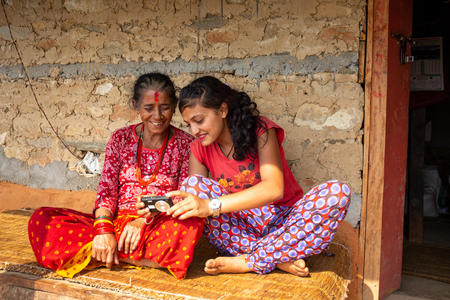
After running a local exhibition to highlight the restrictions they face while on their period, Manisha went on to share her experiences with more teenage girls – sparking an even wider conversation about the taboos surrounding menstruation in Nepal.
Dignity for women with disabilities
For women and girls living with a learning disability, it’s even harder to access essential information about menstruation. The Bishesta campaign shared hygiene and health messages in an inclusive way – supporting all women to manage their periods with dignity.

Harnessing the power of the natural landscape
The Foundations for the Future project uses innovative technology to bring clean water to one of Nepal’s remotest regions.
The rugged, mountainous terrain of Dolakha makes fetching water on foot time-consuming and treacherous – but ideal for gravity-fed water systems.
Together with local leaders, partners and community groups, we’re installing a gravity flow system that will bring clean water to every household in the area. We’re tapping into quality water sources high in the mountains, then using the power of gravity to carry it downhill, where it’s treated and stored before being piped to individual tapstands.
Earthquake-resistant, cost-effective to run, and maintained by members of the community – it’s the perfect solution for this mountainous region.
Rebuilding lives after disaster strikes
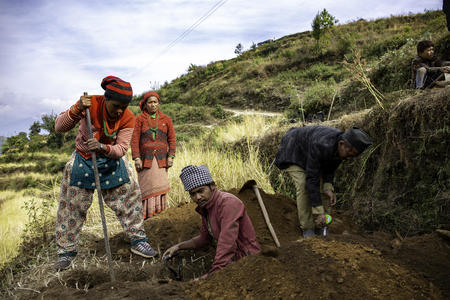
In 2015 Nepal was hit by two catastrophic earthquakes, killing almost 9,000 people and destroying thousands of water supplies and toilets. In the months and years that followed, we’ve worked with communities to rebuild taps and toilets in the worst-hit areas – stopping diarrhoea claiming even more lives.
We’ve been working with plumbers like Krishna Sunuwar as he helps his remote village of Kharelthok recover:

Giving children the best start in life
Clean water, safe facilities and good hygiene practices are essential for keeping babies healthy.
Hygiene promotion through immunisation
In Nepal, a new mother will take her baby to an immunisation clinic at least five times in the first nine months of the child's life. It’s the perfect opportunity to promote hygiene behaviour change – and our groundbreaking project, Hygiene promotion through immunisation, is doing just that.
We’re working with the Ministry of Health to embed essential hygiene information and education into the national routine immunisation programme, so reaching thousands of mothers and their babies.
Healthy Start
Supported by Georgio Armani’s Acqua for Life programme, we’re working with our local partner to improve hygiene at healthcare facilities for mothers and babies across the district of Bardiya. We're improving handwashing and water facilities, training staff, and supporting health workers to share their hygiene knowledge with expecting and new mothers.
Responding to COVID-19
We’ve joined forces with other charities, the UN, and the London School of Hygiene and Tropical Medicine as part of the Hygiene and Behaviour Change Coalition (HBCC): a taskforce dedicated to reducing the spread of COVID-19 through improved hygiene, funded by UK Aid and supported by Unilever.
Over the course of the pandemic, we’ve been working with governments to expand existing hygiene programmes, running public awareness and behaviour change programmes, and building contactless handwashing hubs in health centres and busy public places.
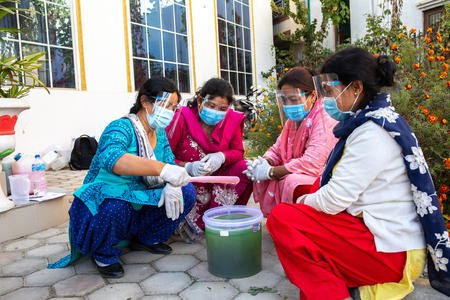
In Nepal, we’ve also trained women in Kirtipur, in the Kathmandu valley, to make liquid soap and face masks, which they then sell at a fair price in the local market. Learning these skills has not only helped improve people’s access to these essential hygiene materials, but has also given households the opportunity to improve their livelihoods with a secure source of income.